A Practical Guide: Software Development for Medical Devices
Mid-sized and large MedTech companies in Europe are under increasing pressure to develop software for medical devices. The software as a medical device (SaMD) market alone is projected to grow from USD 440 million in 2024 to USD 1.4 billion by 2033, indicating robust demand for novel digital solutions.
At the same time, regulatory complexity is slowing many projects. Under MDR Rule 11, most medical device software now falls into Class IIa or higher, with certification times stretching to 13–18 months and creating bottlenecks for innovation. Devices are also expected to be cloud-connected, AI-enabled, and user-friendly, creating demands that legacy development approaches cannot meet.
The core question is: How can companies develop medical device software that meets compliance requirements, integrates with modern infrastructures, and remains scalable for future innovation?
This article provides a practical guide to software development for medical devices. It explains the current challenges, outlines the current development structure, highlights key applications and summarises the best practices for ensuring compliance, safety and maintainability without hindering innovation.
Core Challenges in Software Development for Medical Devices
Developing software for medical devices creates opportunities for innovation, but also introduces major complexity. Addressing these challenges early is critical to keep projects compliant, safe, and on schedule.
Designing for Regulatory Compliance
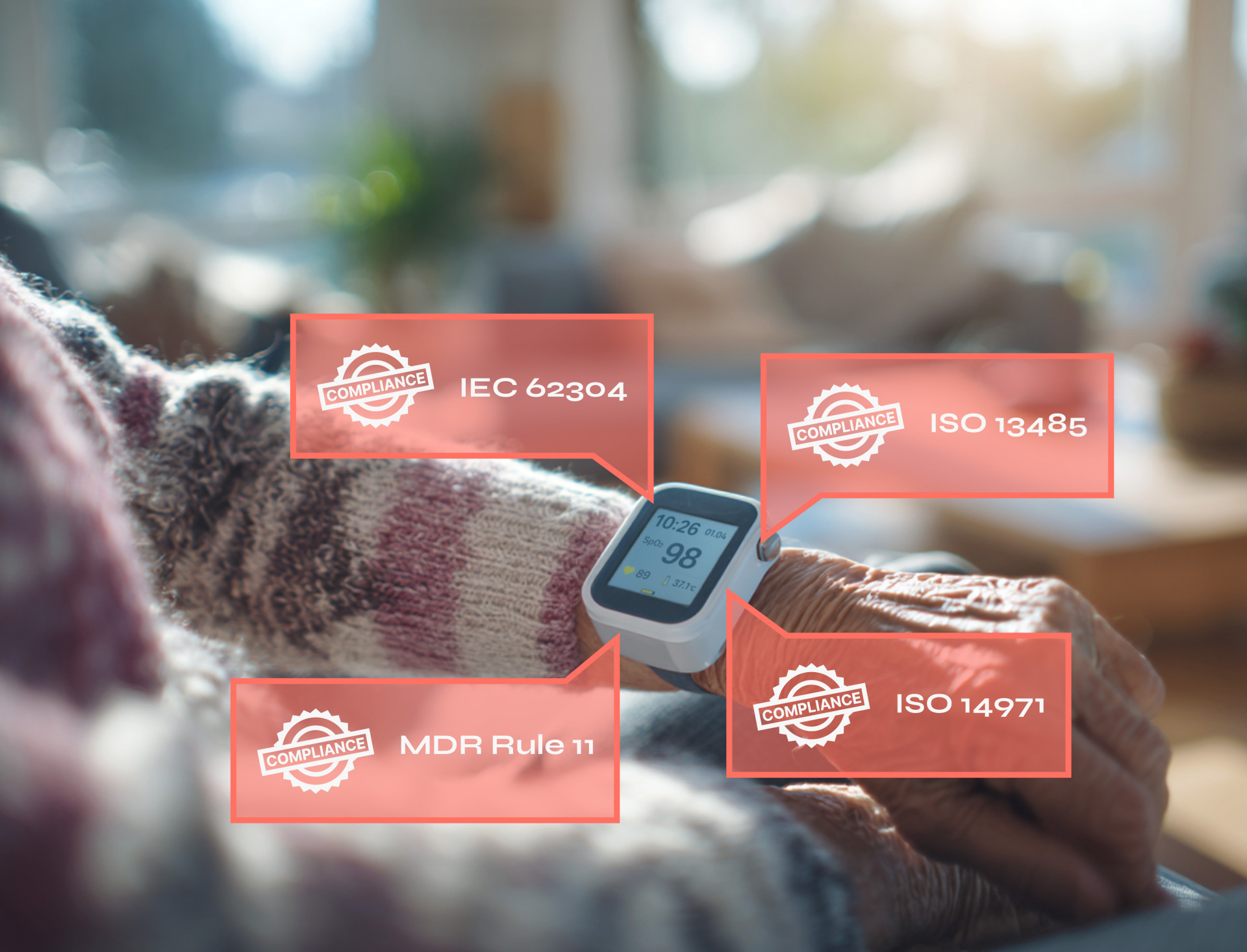
The EU Medical Device Regulation (MDR), ISO 13485, IEC 62304 and ISO 14971 all require rigorous documentation, traceability and risk management across all software components. This extends from embedded firmware to companion apps and cloud systems, all of which require audit-ready records. Failure to meet these requirements can result in certification delays and blocked market entry.
Managing Cross-Platform Complexity
Modern devices combine embedded systems, mobile apps, cloud backends, and hospital integrations. Ensuring performance and secure communication across this stack requires careful architectural planning. Poorly managed integration leads to unstable products that hospitals cannot safely adopt.
Ensuring Clinical Safety and Traceability
Every requirement must be traceable throughout the design, testing and validation processes in order to protect patient safety. Changes in one component can disrupt clinical workflows if they are not fully tracked and verified. Without proper traceability, regulators may reject the product, causing clinicians to lose trust.
Synchronising Hardware and Software Development
Although hardware and software often follow different development cycles, MDR classification applies to the entire system. Misalignment can cause bottlenecks when certification depends on both elements being ready at the same time. When coordination fails, projects stall and costs rise sharply.
Planning for Future Updates and AI Integration
Software must include plans for updates, patches and post-market monitoring, particularly as AI becomes integral to diagnostics and decision support. Architectures should support retraining and controlled updates without triggering re-certification. Without this, companies will face higher maintenance costs and the risk of being withdrawn from the market.
How Software Development for Medical Devices Works
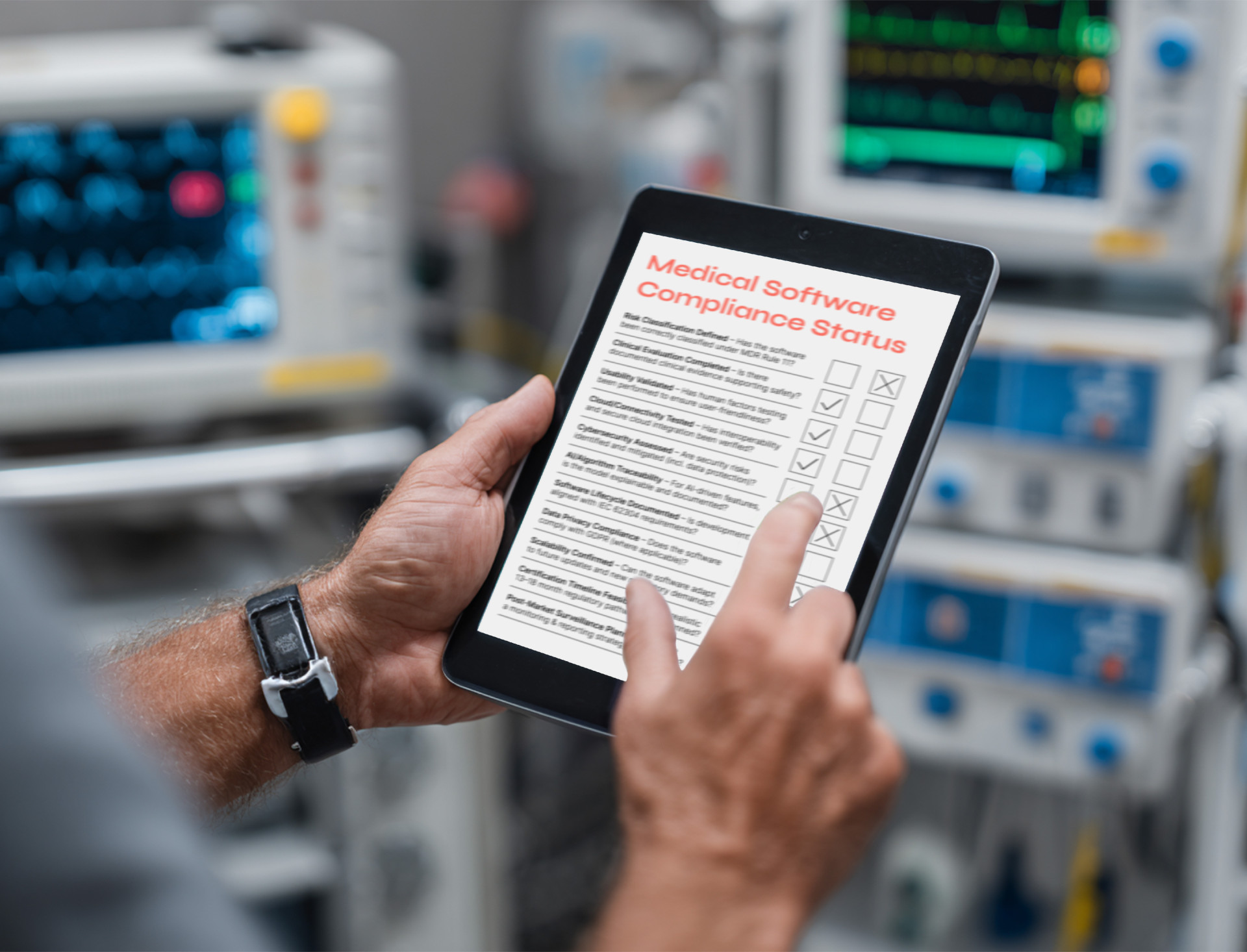
Today, developing medical device software requires a combination of regulatory compliance and modern engineering methods. Teams often use a combination of structured V-model planning and Agile execution to satisfy MDR requirements, while enabling iteration and speed. This balance enables companies to innovate while maintaining audit-ready processes, which is crucial when certification deadlines are already tight.
Architecture and Design
Most projects have a modular architecture, which separates embedded firmware, communication middleware and application logic. This separation makes traceability clearer, testing easier, and updates safer across components. It also facilitates the documentation of requirements and their mapping to verification steps. Without modular design, even minor modifications can have a significant impact on the entire system, causing major delays during the verification and certification process.
CI/CD and Automation
Continuous integration and deployment pipelines can be adapted for use in regulated environments. Each commit triggers the creation of builds, tests and automated documentation, producing artefacts that are fed directly into the quality management system. Automated traceability tools link requirements, risks and test results in real time. Without automation, the documentation process becomes a manual bottleneck, slowing down audits, delaying updates and increasing the risk of errors in regulatory submissions.
Validation and Compliance
Validation is required at every stage, from hardware-in-the-loop testing for embedded systems, to usability studies for mobile apps, to penetration testing for cloud platforms. Compliance checkpoints, such as MDR risk control updates, GDPR security reviews and ISO 14971 hazard analyses, should be incorporated into sprints rather than being left until the end. This integrated approach provides notified bodies with a complete evidence trail and ensures that clinical safety is never compromised. Without continuous management of validation and compliance, projects may be rejected, require redesigns, and face market delays.

Health Applications of Software Development for Medical Devices
Diagnostic Devices
Modern diagnostic tools are becoming increasingly reliant on software for image processing, signal interpretation and automated reporting. These applications use algorithms to help radiologists, pathologists and clinicians make faster and more consistent decisions. When developed in accordance with IEC 62304 and the MDR, such systems provide documented evidence of safety and clinical reliability.
Remote Monitoring Systems
Wearable devices and home-based monitoring equipment collect vital signs and transmit them to cloud dashboards for continuous monitoring. Software development ensures data integrity, FHIR-based interoperability and secure transmission. These systems support the management of chronic diseases and enable healthcare providers to intervene earlier.
Therapeutic Devices
Devices such as connected inhalers, insulin pumps and TENS units rely on software to control dosage, monitor usage and ensure safe operation. The development process incorporates safety mechanisms, error logging and secure data sharing with care providers. Effective software design ensures consistent therapeutic outcomes and enables the tracking of patient adherence.
Clinical Decision Support Tools
AI-driven applications are being integrated into medical devices to assist with triage, diagnosis and treatment recommendations. Developing such software requires compliance with MDR Rule 11, as well as validation through clinical studies. These tools provide clinicians with evidence-based recommendations, thereby contributing to better patient outcomes.
Rehabilitation and Assistive Devices
Computer vision and motion tracking applications facilitate software-driven rehabilitation in areas such as physiotherapy and post-surgery recovery. Accurate movement tracking, safe data handling and integration with clinical dashboards are ensured through software development. When properly validated, these devices help patients to recover faster while providing clinicians with objective data on their progress.
Digital Interfaces for Regulated Hardware
Nowadays, many regulated devices come with companion mobile or desktop applications for data visualisation, device control or patient interaction. These interfaces are developed to align with the intended use and regulatory class of the underlying device. When executed properly, they extend usability and support cross-border interoperability within the European Health Data Space.

Best Practices for Software Development for Medical Devices
Successfully developing medical device software requires a coordinated effort across the technical, regulatory and clinical domains. The following best practices help to ensure that projects deliver safe, compliant and scalable systems without hindering innovation.
1. Build Cross-Functional Teams from the Start
Successful projects require expertise in software engineering, clinical practice and regulatory affairs. Teams should comprise developers who are familiar with IEC 62304 and ISO 14971, clinicians who understand workflows, and compliance experts who are familiar with MDR requirements. Collaborating from the outset prevents discrepancies between technical implementation and regulatory or clinical expectations.
2. Adopt a Phased Implementation Approach
Taking a phased approach that combines V-model planning with Agile execution reduces risk and improves predictability. Initial pilots and low-risk modules can be validated before scaling up to full deployment. This staged rollout helps to maintain clinical continuity while ensuring that compliance is built into every iteration.
3. Prioritize Interoperability and Future Scalability
Design systems with HL7 FHIR and API-first integration to enable communication with electronic health records (EHRs), hospital systems and the emerging European Health Data Space requirements. Modular architecture allows new features or AI components to be added without having to redesign the core system. This future-proofs the system, avoiding the need for costly redevelopment within a few years.
4. Integrate Continuous Testing and Compliance Checks
Automated CI/CD pipelines should generate traceability artefacts and run validation tests in real time, while also maintaining compliance documentation. Integrating regulatory checkpoints into the development cycle ensures that risks are mitigated as soon as they arise. This approach keeps projects audit-ready and prevents certification issues arising at the last minute.

Common Pitfalls in Software Development for Medical Devices
Even the most carefully planned legacy software modernisation projects in healthcare fail if certain risks are overlooked. Avoiding these common pitfalls helps to ensure a smooth transition and a lasting impact.
Neglecting Change Management and User Adoption
Even the most well-developed software will fail if users are not prepared to adopt it. Training, workflow alignment and ongoing support are often overlooked. Without these, clinicians will resist new systems, resulting in lost efficiency gains.
Cutting Corners on Data Quality
Data migration and integration are complex processes, particularly when dealing with HL7 FHIR and legacy systems. If these steps are rushed, the result can be incomplete, inconsistent or corrupted patient data. Poor data quality can undermine both safety and regulatory compliance.
Treating Development as a One-Off Effort
Many companies treat medical device software as a one-off project rather than an ongoing development process. However, regulations, security requirements and clinical needs are constantly evolving. Without lifecycle planning, systems can quickly become outdated and expensive to maintain.
Conclusion: Developing Compliant and Scalable Medical Device Software
The development of medical device software is one of the most demanding areas in MedTech. Outdated approaches are no longer sufficient due to the regulatory complexity, interoperability requirements and cybersecurity risks involved.
The most successful projects follow structured processes combining architectural discipline, phased rollouts, continuous compliance checks and interoperability-first design. Companies that invest in cross-functional teams and ongoing lifecycle management are better placed to meet the demands of the Medical Device Regulation (MDR), integrate AI and cloud technologies, and maintain audit readiness.
With Europe already accounting for 30% of the global SaMD market, organisations that treat software development as an ongoing process rather than a one-off project will be best placed to bring safe, effective and future-proof medical devices to market.
Digital Health & MedTech Solutions we Design and Develop
Our expertise combines advanced digital technologies with the ability to design, develop, and scale certified products for MedTech and digital health use cases.
Telehealth Platforms

Remote Patient Monitoring Devices

Hospital Management Software

NLP for Clinical Documentation

Healthcare Chatbots